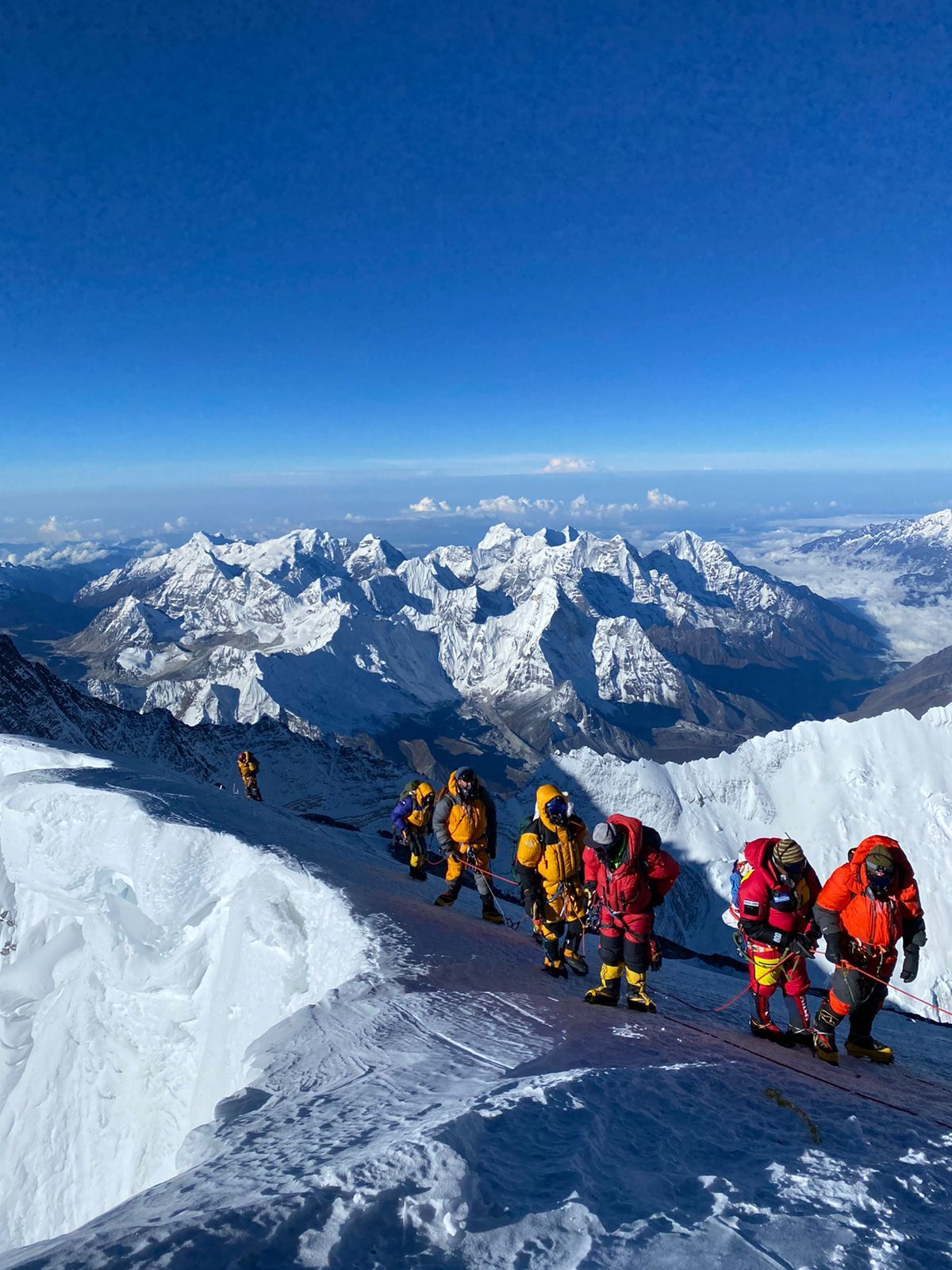
Ama Dablam was first ascended on March 13, 1961, by Mike Gill (NZ), Barry Bishop (USA), Mike Ward (UK), and Wally Romanes (NZ) via the Southwest Ridge. They were well-prepared for high altitudes, having spent the winter at 5800 meters near the mountain’s base as part of the Silver Hut Scientific Expedition of 1960-61, led by Sir Edmund Hillary. Everest considers this more comfortable than the Ama Dablam Expedition, especially when guided by Touch The Himalaya’s professional team.
Ama Dablam is the third most popular Himalayan peak for permitted expeditions. The most famous route, by far, is the original Southwest Ridge ascent. The climb is structured with three camps along the ridge, with the base three just below the hanging glacier’s right, known as the Dablam, to ensure that any ice falling from the glacier avoids the camp.
A climbing permit and a contact official are required for the Ama Dablam Expedition. Climbers need a solid foundation in rock and ice climbing to attempt this mountain. Most of Ama Dablam’s route is fixed, so climbers must be skilled at ascending and descending fixed ropes and passing anchors. One pitch on the route is nearly vertical, so practice climbing a vertical fixed rope before the expedition is essential.
The best climbing seasons are April-May in the spring and September-October-November in the fall. Many climbers combine the Ama Dablam expedition with a trek to Everest Base Camp or an ascent of Island Peak. These options provide an excellent way to acclimatize for the climb.
Trekking to Everest Base Camp is a wonderful opportunity to honor Everest, the King of the Himalayas, and enjoy the classic view from Kallapather. Combining the Ama Dablam expedition with an Island Peak climb offers a unique perspective of Everest from its summit, providing a rewarding and memorable climbing experience.
The standard climbing route uses the Southwest Ridge, with a typical plan of three high camps: Camp One (5600m), Camp Two (5900m), and Camp Three (6200m), with Base Camp at 4500m. Camp Three lies on the ridge’s shoulder, just below and to the left of the final steep snow climb to the summit. In some years, Camp 2.7 is set up, hidden in a narrow corner on the Southwest Ridge between Camps Two and Three. Most climbers summit from Camp Two and do not establish Camp 2.7.
Climbing Ama Dablam from South-west Route Camps:
Base Camp (4600m/15092ft):
Ama Dablam Base Camp is one of the most significant grassy base camps in Nepal. It is rare to find such a favorable landscape at 4600 meters. Climbers often play volleyball and soccer at the camp to stay warm and enjoy the beautiful site. Base Camp will be set up here for almost 45 days during both the spring and autumn seasons. In the middle of the camp, you will have excellent views of Ama Dablam, Thamserku, Taboche, and Kongde.
Ama Dablam’s camp is generally sunny due to its location; the sun rises early and stays late into the day. There are about 7-10 climbing teams each spring and fall season. The camp provides high-quality facilities for climbers, and we arrange climbing permits based on the climbing season. Our guides and staff are always ready to establish various departure dates as requested by climbers.
Camp One (5700m/18,800ft) – 5hrs:
The trek from Ama Dablam Base Camp to Camp One is mostly a hiking trail, with a short section of easy rock scrambling that is about 100 meters long. The trail ends near Camp One at a slope of 60 degrees. Along the way, you will encounter large rocks and climb a simple fourth-class section without fixed ropes. You will quickly learn that there are very few places to pitch a tent on Ama Dablam’s Southwest Ridge, requiring coordination and sharing among climbers. There is space for only about 6-7 two-person tents and 6-7 single tents.
Camp Two (5950m/19,521ft) – 3hrs:
The move from Camp One to Camp Two is the most technical part of the route. You start the day by scrambling and climbing along a fourth-class level rock ridge around several peaks and gendarmes, gaining only 300 meters/1000 vertical feet. The exposure is significant, with large drop-offs on both sides of the ridge. The climbing is beautiful, with excellent quality rock.
At the end of the level ridge, you will climb the Yellow Tower for 6 meters, rated as French fourth class, British Severe, and North American YDS 5.5. Above the Yellow Tower, you will arrive at Camp Two on small ledges. Camp Two feels like a real high mountain camp, with exposure on all sides. Be careful when using the bathroom.
Camp Three (6200m/20,341ft) – 2hrs:
The climb from Camp Two to Camp Three transitions to mixed ice and snow terrain. This section also has fixed ropes along the entire distance. You will have great views of Ama Dablam Base Camp, Kusum Kanguru, and Kantega. It is now time to cross the infamous Mushroom Ridge at 6150 meters/20,300 feet. Looking up at Camp Three (6300 meters/20,800 feet), with the Dablam above, some strong climbers push for the summit from Camp Two.
However, Touch The Himalaya will always set up Camp Three before the summit attempt. This section of the mountain is at high risk for avalanches, so minimizing time spent at this camp or bypassing it is essential. For clients not feeling strong enough to push from Camp Two, we typically spend about six hours here before starting the summit push. The route from the Yellow Tower to Camp Three is nearly 55 degrees of slope almost the entire way.
Summit (6812m/22349ft) – 10hrs:
Summiting from Camp Three and returning to Camp Two takes most climbers around 10 hours. The summit day on Ama Dablam is an extraordinary one. Two straightforward pitches of dramatic yet firm snow ice (40 degrees or more) are climbed to the Dablam’s side. When near the Dablam, you reach a fluted snowfield (30-50 degrees) that leads you to one of the world’s most stunning summits. The view from the top offers the best seat in the house to see the Khumbu, the center of high-altitude climbing. You are rewarded with panoramic views of Lhotse, Nuptse, Mount Everest, Cho Oyu, Pumori, Shishapangma, and Makalu.
Accommodation during the Ama Dablam Expedition
The Ama Dablam Expedition is a 25-day journey. This expedition package includes three nights in a selected hotel in Kathmandu with breakfast. However, meals in Kathmandu are not covered.
You will spend 21 nights in the trekking regions. We provide five nights’ accommodation in rooms with attached bathrooms at Phakding, Namche (3N), and Lukla. Additionally, you will stay in standard rooms at Tengboche (2N) and Dingboche (2N) for a total of four nights. The remaining 12 nights will be spent in tented camps. All accommodations are on a twin-sharing basis.
We provide all camping equipment, including tents (dining, toilet, sleeping), tables and chairs, mattresses, and sleeping bags.
Meals while climbing Ama Dablam
During a high-altitude expedition like Ama Dablam, it is crucial to have nutritious, tasty, and hygienic food. We ensure you receive three meals each day—breakfast, lunch, and dinner. We select the best available lodges/teahouses/hotels that offer fresh, hygienic, and nutritious local or international meals.
You can choose from a variety of traditional, local, Asian, and Western cuisines. However, as you ascend, food choices become limited and more expensive.
We highly recommend consuming garlic soup and other liquids such as green tea, lemon tea, hot lemon, and ginger tea.
Please avoid dairy, alcoholic, and caffeinated items during the expedition, as experts recommend avoiding them for high-altitude adventures.
Our expedition team includes experienced and highly qualified cooks and kitchen helpers at Base Camp and other camps. We provide kitchen and dining equipment for all camps.
Meals (except breakfast) in Kathmandu are not included in the expedition package. In Kathmandu, you can enjoy a wide variety of Nepalese and international cuisine at fine dining restaurants, snack bars, and pubs.
Best Seasons for Ama Dablam Expedition
The weather is a critical factor when planning your expedition. The best times for trekking and climbing Ama Dablam are spring (March to May) and autumn (September to November). Summer in Nepal coincides with the monsoon season, making the trails wet and slippery. In winter, high-altitude temperatures drop significantly, and heavy snowfall makes trekking difficult. Here is a brief overview of the weather at high altitudes throughout the year.
January – February: This period is the coldest, with heavy snowfall in the mountain region and frigid temperatures. Daytime can be warm with clear blue skies, but nighttime temperatures are extremely low. Expeditions during these months are not advisable due to the challenging conditions.
March – April: These months offer highly favorable conditions for the expedition, with stunning views of the Himalayan ranges and glaciers. Temperatures start to rise from mid-March, and the clear blue sky enhances the beauty of the snow-capped mountains. Expedition success rates are high during these months.
May – June: This period is the second-best season for the expedition, just before the monsoon starts in late June. Spring and early summer provide enjoyable conditions for the climb.
July – August: The monsoon season brings heavy rain to the lower trekking regions, making trails slippery and increasing the difficulty of the expedition. Flight cancellations or postponements to Lukla are common due to poor weather and visibility.
September – October: This is a peak season for the expedition, with pleasant weather and favorable conditions. High-altitude daytime temperatures can reach up to 20°C (68°F) and drop to around 5°C (41°F) at night. Clear blue skies provide stunning views of the Himalayas. The Hindu festivals of Dashain and Tihar add a festive atmosphere to the region.
November – December: As winter sets in, snowfall gradually covers the Himalayan region, making trekking challenging. Late October and early November are busy for expeditions, with stable daytime temperatures but frigid nights. The clear blue skies and snow-clad mountains offer picturesque views. By December, colder days and heavy snowfall make the trek routes more difficult.
Please Note: The weather in the Himalayas is unpredictable, and temperatures can change quickly.
Equipment List for Ama Dablam Expedition 2024
The following gear is essential for the Ama Dablam Expedition. Please ensure you have all the listed equipment, and verify that each item fits and functions correctly. Many items can be purchased or rented in Kathmandu, where both branded and locally manufactured trekking gear is widely available.
Head Gear:
- Sunhat x1
- Warm hat (should cover head & ears comfortably) x2
- Buffs x2
- Sunglasses/Glacier Glasses (high-quality, UV-blocking sunglasses with good all-around protection) x1
- Ski Goggles (anti-fog and good ventilation)
- Headlamp with spare batteries (200-300 lumens output) x2
Upper Body:
- Thermal or fleece base layer top x3
- Trekking shirts/t-shirts (breathable & quick-dry materials) x3
- Midweight top x2
- Soft-shell jacket/fleece jacket x2
- Prima-loft or light down jacket x1
- Waterproof jacket x1
- Hardshell Gore-Tex jacket with hood x1
- Insulated down jacket with hood x1
- Expedition down suit x1
Lower Body:
- Thermal or fleece base layer bottom x3
- Trekking trousers/pants x3
- Midweight trousers/pants x2
- Waterproof pants x1
- Hardshell Gore-Tex pants (non-insulated and waterproof) x1
- Insulated down pants x1
- Hiking boots x1
- Camp shoes x1
- 8000m mountaineering boots x1
- Hiking socks (medium to heavy, synthetic and wool) x4 pairs
- Liner socks x2 pairs
- Summit socks x2 pairs
- Flip flops x1
Handwear:
- Liner gloves x2 pairs
- Midweight gloves x1 pair
- Heavyweight gloves (leather palm) x1 pair
- Down mittens / Summit gloves x1 pair
Gear / Personal Equipment:
- Daypack (45-55 liters, for carrying water and personal items during trekking and climbing)
- Duffel bag (provided upon request)
- Down sleeping bag (-20°C rated) for Base Camp
- Down sleeping bag (-30°C rated) for higher camps
- Thermarest mattress
- Water bottle (1-liter capacity, Nalgene) x2
- Insulated cover for water bottle x1
- Trekking poles x1 pair
- Camera with charger or spare batteries
- Personal snacks and energy bars
- Laundry bag for dirty clothes
- Padlock
- Large plastic bags to keep clothes dry
- Extra clothes for wearing in Kathmandu
- Umbrella / Poncho
Toiletries and Hygiene:
- Quick drying towel
- Small face towel
- Toothbrush & toothpaste
- Face mask
- Water treatment tools
- Soap and shampoo (small bottles)
- Face and body moisturizer
- Sunscreen (SPF 30+) and Lip balm (SPF 30+)
- Hand sanitizer / Antiseptic wipes
- Hygiene products
- Basic first aid kit
Climbing Gear:
- Helmet
- Ice axe
- Crampons
- Harness
- Carabiners (3 screw gate and 3 snap gate)
- Descender (ATC guide/Figure 8)
- Ascender / Jumar (large handle)
- Prusik cord x2
- 8mm climbing cord (3 meters)
- Avalanche transceiver (if possible)
Documents:
- Passport with at least 6 months validity
- Credit cards for emergencies
- Driving ID or another form of ID in case of passport loss
- Travel insurance (refer to the general information page for more details)
- Flight tickets
Acclimatization in various camps during the Ama Dablam Expedition
You will acclimatize at least four times during the expedition. The first acclimatization will be in Namche Bazaar (3,440m / 11,285ft), followed by Dingboche village (14,468ft / 4,410m). You will also have acclimatization periods during the Ama Dablam peak climb.
Namche is a vibrant town with Wi-Fi-linked cafes, restaurants, and shops selling everything from clothing to climbing equipment. While acclimatizing, you can take side treks to the Sagarmatha National Park Visitor Center and visit the Khunde and Khumjung villages. Hiking to Everest View Hotel offers views of Mt. Everest (8,848m).
Another acclimatization day awaits in Dingboche, where you can hike to the top of Nangkartshang Peak (5,083m) for views of Mt. Tawache, Ama Dablam, Island Peak, Lhotse, Everest, and Pumori. You can also reach Chhukung Ri (5,546m), a famous trekking peak.
Acclimatization continues at various camps during the climb.
Travel Insurance Policy for climbing Ama Dablam
The Ama Dablam Expedition is strenuous, with risks of high-altitude climbing, potential altitude sickness, and sudden climate changes. Travel insurance is mandatory for this expedition. All members must provide a copy of their comprehensive travel insurance policy certificate to Touch The Himalaya, before starting the trek. The policy must cover medical and emergency repatriation, including helicopter rescue and evacuation expenses up to the highest expedition altitude.
We can recommend insurance companies based on previous client experiences, but we do not sell insurance policies. We may refuse expedition members who lack sufficient or proper travel insurance.
Expedition members should send detailed insurance information after booking the expedition. In emergencies, we will use this information for quick and effective rescue operations and medical transfers.
Make sure your insurance company covers the cost of mountain rescue services up to the highest expedition altitude. Verify with the insurer that helicopter rescue is included up to the highest altitude (6,000m) before purchasing the policy.
Passport and Visa
All foreigners, except Indians, require a visa to enter Nepal. Most nationals can obtain an on-arrival visa at Tribhuvan International Airport or immigration checkpoints along the Nepal-India or Nepal-China border.
For a visa application, you need a passport with at least six months of validity, a passport-size photo, and visa application fees. The current cost is USD 50 for a 30-day stay.
Citizens of China and SAARC countries (Bangladesh, Bhutan, India, Pakistan, Sri Lanka, and the Maldives) are eligible for free visas. Citizens of certain countries, including Nigeria, Ghana, Zimbabwe, Swaziland, Cameroon, Somalia, Liberia, Ethiopia, Iraq, Palestine, and Afghanistan, may not receive an on-arrival visa and should contact their local Nepalese embassy. Visit Nepal Immigration for the latest information.
Safety during the Ama Dablam Expedition:
Touch The Himalaya guarantees client safety and security. The health and safety of our clients are our utmost concern. Our guides are experienced in extensive first aid.
Altitude sickness is common at high altitudes, and our Sherpas are well-equipped, experienced, and prepared to prevent, deal with, and treat altitude sickness.
Our expert team will support you to prevent altitude sickness, including acclimatization needs. We conduct extensive weather research and use the latest gadgets and technologies for climbing and communication.
We request Ama Dablam expedition members send detailed insurance information upon booking. In emergencies, we will use your insurance policy and information for quick and effective rescue operations and medical transfers.
For any confusion on Ama Dablam Expedition or booking process feel free to CONTACT US.